When I was serving in student ministry with Student Life in New Zealand, evangelistic preaching was a big part of our outreach events. On the college campus where I worked, we often planned gatherings that connected with the daily lives of students.
We would relate to students through music, activities or conversations that connected with their experiences, interests and struggles. After building a connection with the group, we would share the gospel message.
These moments remind me of the power of clear, simple preaching to point people toward Jesus. For a clear explanation, check out our evangelism definition post, which covers what evangelism is and how it works.
An Overview of Evangelistic Preaching
Evangelistic preaching is a great tool for spreading the message of Jesus Christ. This type of preaching focuses on presenting the message of the gospel and offering people the chance to become followers of Christ.
While my ministry team focused on student events, many ministries use evangelistic preaching in church services or community gatherings. The majority of evangelistic preaching is done inside the walls of a church. Churchgoers invite friends to come to church to hear the message of forgiveness as a way back to God.
The approach not only highlights the importance of sharing one’s faith but also deepens understanding of spiritual truths. While the nonbeliever might be hearing this message for the first time, Christians also grow in faith through hearing these biblical truths.
Evangelistic preaching invites both believers and non-believers to explore their relationship with Christ. This is because it effectively communicates God’s love and salvation.
I hope the comprehensive guide I’m providing here will equip and inspire you to share the powerful message of the gospel. To jump straight to the six core components of gospel preaching sermons, click here.
The Importance of Evangelistic Preaching
Historically, evangelistic preaching has been foundational, dating back to the early church. The apostles boldly declared the message of Jesus Christ. There are many examples of this in Scripture. Here are three:
- In Acts 2:14-41, Peter explained that Jesus’ death and resurrection fulfilled God’s promises. He called the listeners to repent and be baptized.
- In Acts 8:4-8, Philip went to the city of Samaria and proclaimed Christ to the people there.
- In Acts 17:16-34, Paul preached the message of Jesus to those in Athens.
Throughout history, this form of evangelism was a critical method for spreading the gospel in often hostile environments. Influential figures like John Wesley and George Whitefield harnessed this technique to spark spiritual awakenings. These men demonstrated the profound societal impact of passionate, direct faith-sharing.
At the center of evangelistic preaching is the good news of Jesus Christ.
Today, evangelistic preaching continues to impact local communities by addressing spiritual needs and offering hope and healing. It encourages community engagement, prompting congregations to reach out and invite friends to events where the gospel is preached.
Events such as open-air meetings and community gatherings create relatable contexts for sharing the gospel. This facilitates conversations that lead to personal connections with Christ.
Local churches that take this approach often notice positive changes in their communities. Working together to share our faith becomes a natural part of daily life. They see an increase in personal evangelism in churchgoers.
Communities benefit from evangelistic events in a number of ways.
- People come together with a similar purpose in mind.
- People connect with one another on a spiritual level.
- People are reminded of the hope that is offered through Jesus.
This preaching style also significantly contributes to church growth. Churches that embrace evangelistic preaching often experience an influx of new attendees seeking spiritual answers. This growth goes beyond than numbers; it represents a deeper connection with faith.
Evangelistic preaching cultivates an environment where faith can thrive, leading to vibrant church communities. People come together with the shared goal of inviting friends to hear the message of salvation.
Key Elements of Evangelistic Preaching
Before we get into the how-tos of this kind of preaching, I want to pause and point out something important. This isn’t about us—it’s not about our preaching skills, our preparation, or even the parts of a good sermon. At the end of the day, God is the one in control.
Even when our sermons fall short, the Holy Spirit can still move in the hearts of those listening. So let’s always begin evangelism with prayer. Invite God to speak through your words and move in the hearts of the people hearing them.
This type of sermon invites individuals to experience the gospel’s transformative power. To convey this message effectively, preachers must embrace key elements that enhance communication and impact.
Centered on Scripture
Strong evangelistic preaching always starts with Scripture at the center. These sermons draw on passages that highlight God’s love, grace and truth. By using specific verses and biblical narratives, preachers provide a solid framework for their message. This lends authority and connects the audience to the Bible’s historical and spiritual context.
Here are some examples of content that could be used for gospel-sharing sermons:
- Parables of Jesus – Stories like the Prodigal Son (Luke 15:11–32) or the Good Samaritan (Luke 10:25–37) illustrate God’s love and mercy in ways that listeners can relate to.
- Accounts of life change – Passages such as Saul’s conversion on the road to Damascus (Acts 9:1–19) show the power of God’s grace to change lives.
- Calls to repentance and faith – Verses like John 3:16 or Romans 10:9–10 clearly present the path to salvation, emphasizing God’s truth and the response He desires from us.
In this Tabletalk article, Eric Alexander explains that any Scripture in all of the Bible can be made into an evangelistic sermon. I love this idea! The story of redemption begins in Genesis and ends in Revelation. Pastors and speakers don’t need to stick to John 3:16 to present the truth of Jesus’ death and resurrection.
Easy to understand
Evangelistic preachers should always make their message clear and easy to understand. This means they should avoid jargon or complex theology. Some great ways to engage the listeners:
- Storytelling
- Relatable examples
- Interactive elements that invite participation
Tools like the JESUS film can enhance engagement by visually portraying biblical stories. This can make the message accessible to diverse audiences. The film is also broken up into 62 clips, so you can use a shorter clip to get your message across.
Inspires action
A compelling call to action is vital. Evangelism sermons should culminate in a specific invitation for listeners to respond to the message of Christ. Ask the listeners to consider accepting Christ, joining a community of believers, or exploring their faith further.
Clear next steps help individuals understand their response and take ownership of their spiritual journey. Some follow-up steps could include:
- Evangelistic tracts to revisit the message they heard.
- Basic follow-up resources like Foundations of Faith.
- Prayer opportunities.
Effective evangelistic preaching relies on a biblical foundation, message clarity and a simple invitation to respond. By focusing on these elements, preachers can inspire audiences to embrace Jesus Christ’s life-changing message.
6 Core Components To Communicate Your Evangelism Sermon
1. Cultural connection (The hook)
An evangelistic message often begins with a connection point that meets people where they are. This could be a story, a question or an observation about culture that draws attention and builds common ground. The goal is to show that faith is not abstract but relevant to real life. Other examples of cultural connections could be sports, music or performing arts.
During my time serving in ministry, we connected to the culture through various topics. I remember one outreach where I spoke to college women about self-confidence. This was an area that I had noticed many women struggled with.
I was able to share my struggle with self-esteem with them. This built a bridge to a “felt need” within each listener. A felt need is something a person recognizes as important or missing in their life and actively seeks to fulfill.
Biblical example: Paul begins with the Athenians’ altar “To an unknown god” as a cultural bridge (Acts 17:22–23).
2. Problem of sin (The need)
Once listeners are engaged, the message should clearly explain the human problem: sin separates us from God. This is not about condemning people but about helping them recognize a truth we all share—we fall short and cannot fix ourselves. Making the need clear prepares hearts to understand why the story of Jesus matters.
At that outreach event, I shared how I had tried again and again to find significance, but I always came up empty. At the time of the event, I was a professional cheerleader, featured in magazines and on TV. I had a loving husband who cared for me.
By society’s standards, I had everything—but deep down, I still fell short of God’s perfection. I used my own story to show others how sin affects everyone and how are all in need of a savior.
Biblical examples:
- “For all have sinned and fall short of the glory of God.” — Romans 3:23
- “Your iniquities have separated you from your God.” — Isaiah 59:2
3. Christ’s work (The gospel message)
At the center of evangelistic preaching is the good news of Jesus Christ. His perfect life, sacrificial death and victorious resurrection provide the way back to God. This part of the message should be direct, simple and full of hope. Christ’s life, death and resurrection are the heart of our Christian faith and the foundation of real life change.
In my campus talk, I shared the message of salvation through what Jesus did on the cross. I explained that He lived a perfect life and willingly took my sins upon Himself when He died. And it wasn’t just my sins—He carried the sins of the whole world.
Biblical examples:
- “For what I received I passed on to you as of first importance: that Christ died for our sins according to the Scriptures, that he was buried, that he was raised on the third day according to the Scriptures.” — 1 Corinthians 15:3–4
- “Jesus said, ‘I am the way and the truth and the life. No one comes to the Father except through me.’” — John 14:6
4. Personal application (The bridge)
How do we help listeners connect the message of salvation to their personal story? We have to communicate that the message is not just an idea from history but a living truth for today. A smooth transition from explaining the truth of Christ to applying it makes the message relatable and persuasive.

I shared that only in Christ did I finally discover my true worth. My value comes from my relationship with Jesus. In Him, I am fully loved, no matter what. His grace—not anything I could do—brought me unconditional acceptance. This explained the grace of God through Christ’s death on the cross.
Biblical examples:
- “The life I now live in the body, I live by faith in the Son of God, who loved me and gave himself for me.” — Galatians 2:20
- “If anyone is in Christ, the new creation has come.” — 2 Corinthians 5:17
5. Call to respond (The invitation)
An evangelistic sermon should always provide an opportunity to respond. This could be an invitation to trust Christ for the first time, a call to prayer or an encouragement to take the next step of obedience. The invitation should be clear, gracious and full of expectation that God is at work in people’s hearts.
I gave the listeners an opportunity to respond. I asked them to take a moment, take a breath in and out, and consider what Jesus had done for them personally. This wasn’t about me, but about each one of them individually. I prayed a simple prayer aloud, allowing them to repeat the phrases inwardly, as a conversation between them and God.
Biblical examples:
- “If you declare with your mouth, ‘Jesus is Lord,’ and believe in your heart that God raised him from the dead, you will be saved.” — Romans 10:9
- Jesus says, “Here I am! I stand at the door and knock.”— Revelation 3:20
6. Follow-up strategy (The comment card)
A follow-up strategy is an important next step after an outreach event. Using something like a comment card allows attendees to share their thoughts about faith.
During the event, set aside a couple of minutes for people to fill out the cards and make sure pens are available. You could also create an online form, which attendees can access on their phone using a simple link or QR code.
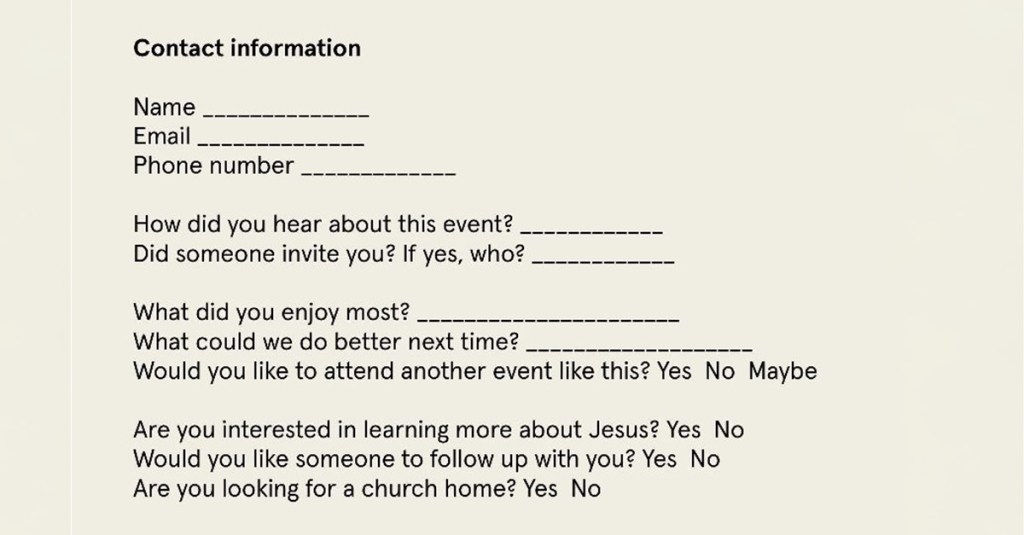
Get in touch with interested people within 24 hours of the event. Follow-up should be warm, encouraging and personal, showing that you care about each individual’s journey. This follow-up provides an opportunity to guide people toward next steps or exploring a relationship with Christ more deeply.
On the comment cards for my women’s event, I was able to see that a girl named Julia had prayed to receive Christ during the prayer time. Because she filled out a comment card, I was able to connect with her one-on-one. We met for follow-up and continued a growing relationship with each other.
Biblical examples:
“I have no greater joy than this, to hear that my children are walking in the Truth.” — 3 John 1:4
Techniques for Effective Evangelistic Preaching
Evangelistic preaching has been an effective tool for sharing Jesus since the days of the early church. If we learn how to do it well, we can reach more people with the love of Christ.
Four tactics to embrace for this type of evangelism are creating an encouraging atmosphere, storytelling, using multimedia, and holding small group discussion.
Inviting atmosphere
Creating an inviting atmosphere is essential for effective evangelistic preaching. When individuals feel welcomed and comfortable, they engage more with the message. Thoughtful church decor, warm greetings and a friendly environment contribute to this. Consider having coffee, tea and snacks in the church lobby or just before your talk so people approach it feeling relaxed.
This blog post by Larry Moyer notes that enthusiasm makes a big difference. The message of Jesus should be shared in a way that’s engaging, not boring.
Storytelling
Stories connect emotionally with people, making the message relatable and memorable. When we share our faith experiences, we illustrate the gospel’s power. This invites others to consider their own spiritual journeys. Personal testimonies break down barriers, encouraging listeners to explore their relationship with Christ.
Using media
Using multimedia resources is another vital technique. In today’s digital age, videos, slideshows and audio clips captivate audiences and reinforce evangelistic outreach sermons. Visit Alex Rodriguez’s blog on digital evangelism here.
The Jesus Film Project® YouTube page is a great resource that features full-length films, short clips and engaging attention-getters. By integrating videos into sermons, we appeal to various learning styles, ensuring our message connects with our audience.
Small group discussions
Small group discussions allow participants to share thoughts and experiences related to the message. This deepens understanding and builds relationships among attendees.
Consider sharing discussion questions to help guide conversations, such as:
- What part of the message stood out to you the most, and why?
- How did the presentation challenge the way you think about your relationship with God?
- What does faith in Jesus mean to you personally after hearing the message?
- Is there something in your life you feel God is asking you to change or surrender?
- Who in your life could benefit from hearing this message, and how might you share it with them?
Sharing the Gospel Through Corporate Evangelism
The Great Commission, outlined in Matthew 28:19-20, is a foundational command for Christians to spread Jesus Christ’s message. This divine mandate calls us as believers to make disciples of all nations, teaching them to observe Jesus’ commands.
The Great Commission carries an important message, inviting every Christian to participate in evangelism. Inviting others to an event is one way of sharing the gospel’s transformative power. This task is not reserved for a select few but is a collective responsibility.
There are many types of evangelism that we engage in as believers.
Let’s look at two types of evangelism here: personal and corporate. Personal evangelism involves one-on-one interactions, sharing faith through personal testimonies and relationships. This intimate approach allows deep connections, fostering trust and openness.
In contrast, corporate evangelism occurs in larger settings, like church services, community events, or outreach programs, where the message is delivered to a group. It has the scope to reach more people at one moment in time.
Both methods are necessary. Personal evangelism cultivates individual relationships, while corporate evangelism reaches broader audiences, creating opportunities for collective engagement and response. Every Christian can be involved in both of these.
Challenges in Evangelistic Preaching
Despite its power, evangelistic preaching comes with challenges. Many Christians feel intimidated about sharing their faith, fearing rejection or failure. The idea of standing in front of a crowd and sharing the gospel can be daunting.
Overcoming this fear is essential. We can find comfort in knowing that evangelism is about planting seeds (1 Corinthians 3:6). It isn’t our job as speakers to work in people’s hearts. Only God can make these spiritual seeds grow.
One of the best and most freeing definitions of success in this area that I have heard is this: “Success in evangelism is simply taking the initiative, in the power of the Holy Spirit, and leaving the results to God.”
That saying helps us to realize that it is all in God’s power. The results aren’t up to us.
Building relationships is key to effective evangelistic outreach sermons.
Another challenge is navigating cultural barriers and misconceptions. In a diverse world, we encounter audiences with varying backgrounds, beliefs and values. Read about cross-cultural evangelism here.
Cultural differences can lead to misunderstandings. For instance, phrases or concepts familiar to one culture may be strange in another. We should practice cultural sensitivity and educate ourselves about the communities we aim to reach. This ensures our message is relevant and respectful.
Diverse audiences present further complexity. Each audience has expectations and interpretations of faith. We should keep in mind diverse perspectives when we’re preparing to speak. This involves being attuned to the audience’s emotional and spiritual needs.
Resources for Evangelistic Preaching
Evangelistic preaching is a powerful tool for sharing Jesus Christ’s message, and having the right resources can enhance effectiveness.
Here are some resources to consider for evangelistic sermons:
- Online articles and blogs dedicated to evangelism
- Workshops and training programs like Evangelism Coach
- John Piper extensive writings on preaching techniques
- The Gospel Coalition’s online course on preaching God’s Word.
By leveraging these resources, you can understand your audience better, refine your preaching style and share evangelistic messages more effectively.
Each step in honing your skills will help you in the desire to reach others with God’s plan of redemption.
Taking Your Next Step in Evangelistic Outreach
Building relationships is key to effective evangelistic outreach sermons. Investing time in getting to know others, listening to their stories, understanding their struggles and sharing in their joys creates a platform for genuine dialogue about faith.
Some of us are called to preach in this way. Others are called to share Christ’s hope simply by inviting friends and loved ones to an evangelistic event. Whatever God is putting on your heart, take that step—don’t wait!